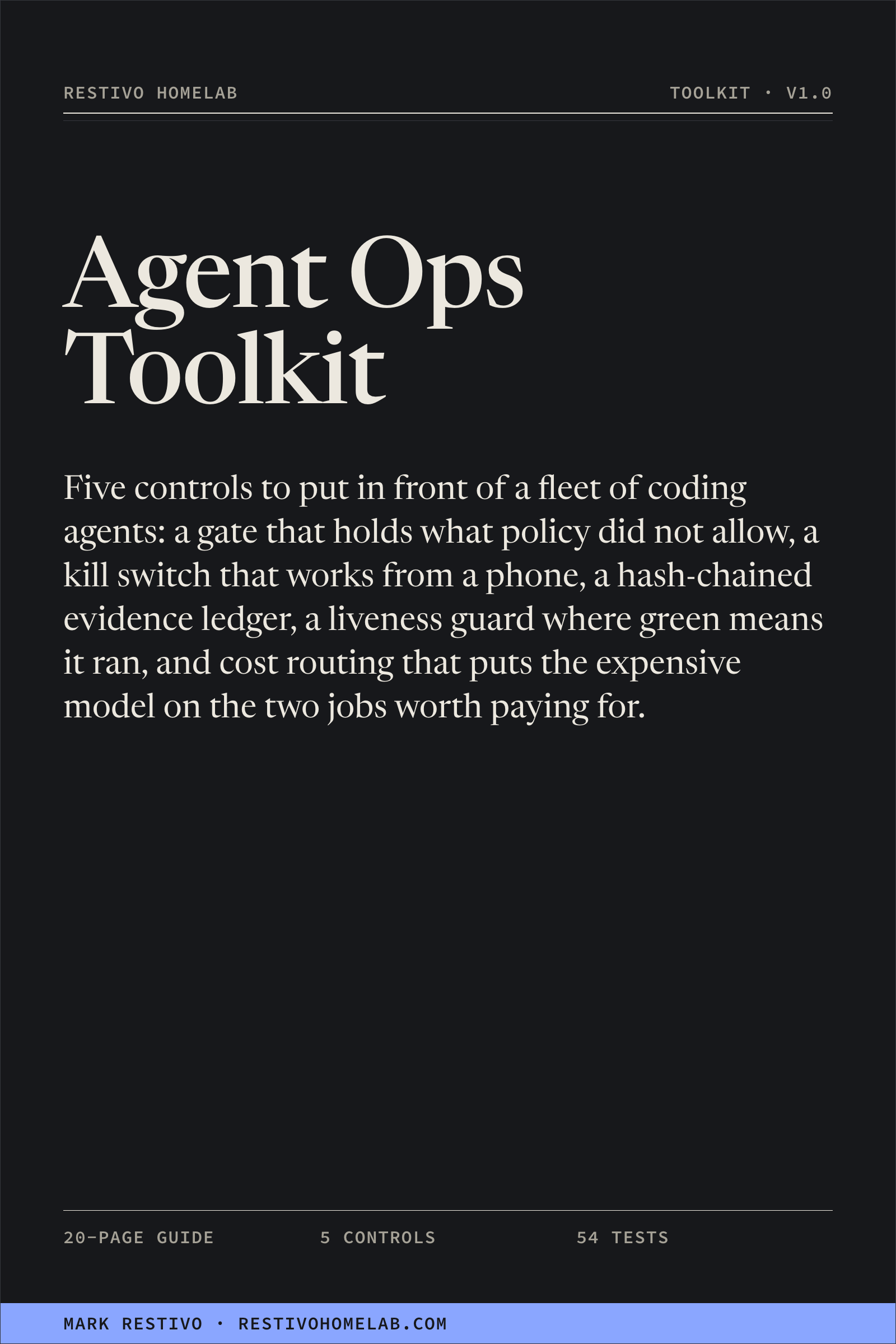
Five controls to put in front of a fleet of coding agents: a gate that holds what
policy did not allow, a kill switch that works from a phone, a hash-chained evidence ledger, a
liveness guard where green means it ran, and cost routing that puts the expensive model on the two
jobs worth paying for.
$99 minimum, $129 suggested
Pay what you think it's worth, with $99 as the floor. Team licence (5 seats) $299.
Available December 10. Join the list to get it first.
Version 1.0, five controls, a Claude Code hook, three scheduler examples, 43
tests and a 20-page guide, updated December 2026.
Free updates forever. 30-day 100% refund, no questions.
The code is MIT — the guide is the paid part. No subscription, no account, no
DRM.
A single agent session fails in front of you — you see the wrong file being edited, you press
escape. A fleet fails differently. The moment work runs while nobody is watching, the failure modes
stop being "it did the wrong thing" and become "it did the wrong thing, and nothing said so". This
is what I run instead.
After this you will be able to…
Stop an action nobody would have approved. The gate checks a command, a
path, a budget and a human approval token before the action happens, and holds what policy did
not allow. It runs as a Claude Code PreToolUse hook, as a wrapper for Codex CLI or
your own loop, or as three lines of Python.
Stop the whole fleet from your phone. The kill switch is a file every loop
checks, so it also stops the run that has not started yet — which a signal cannot. Missing,
corrupt or unreadable all mean killed: it fails closed.
Answer "what actually happened" with evidence. The ledger is append-only
JSONL, each line carrying the hash of the line before it. Edit one and
ledger verify names it.
Tell whether a job ran, not whether it is configured. Liveness derives green
from one number — the age of the last success — so a job that stops decays to late, stale and
dark on its own, even with the machine switched off.
Know what last night cost, before the invoice. Roles route to model tiers,
spend is recorded per run in the ledger, and a run cap and day cap stop a loop rather than
letting it find its own limit.
The two ideas
Policy is authority, not documentation.policy.json is written by a
person and read by agents; the shipped default denies writes to it. That sounds like a nicety until
you watch a capable agent fix a failing gate by editing the policy that failed it.
Green means it ran. This came out of a real failure — a status tile that stayed
green for nine days while the machine running the job was off. Nothing alerted, because nothing had
failed. Things had simply stopped happening.
What's in the download
The agentops package — gate.py,
killswitch.py, ledger.py, liveness.py,
cost.py, cli.py. Python standard library only, MIT licensed, about a
thousand lines you can read in a sitting.
The Claude Code hook — hooks/pretooluse-gate.sh, which fails
closed on a payload it cannot read, passes arguments NUL-separated so a command containing
quotes or newlines reaches the gate exactly as it will run, and works on the bash 3.2 that
macOS still ships.
run-with-gate.sh — the same policy in front of Codex CLI, a
Makefile, or any loop with no hook system, plus a run id that ties every decision, command and
dollar together in the ledger.
The liveness wrapper — kill-switch check, run, record — with the recording
in a shell trap, so a job killed mid-run records a failure instead of staying green.
Scheduler examples — crontab, a systemd service and timer with
Persistent=true, and a launchd plist with the two traps that silence macOS jobs
written into the comments.
54 tests — python3 -m unittest discover -s tests -t .. Each one
breaks a control on purpose: a kill flag that will not parse, a ledger line edited after the
fact, an approval token used twice, a job whose last success is three days old.
20-page guide, PDF and Markdown — why fleets fail silently, the five
controls and what each refuses to do, install, wiring into Claude Code and Codex, running a
nightly loop safely, a worked incident read from the ledger, the cost-routing arithmetic with
the numbers, a 10-item pre-flight checklist, and an appendix of traps.
policy.example.json — generated from the code at build time, so
the documented policy cannot drift from the one the gate enforces.
Everything is plain text: Python, bash, JSON, Markdown, one PDF. No network calls anywhere in
the toolkit, no daemon, no account, no pip install. Nothing that stops working if this
site does.
Who this is for
Anyone running an agent unattended. One nightly job counts. The controls
become worth their cost at exactly the point where you stop watching each run.
People running more than one agent at once. Three agents on three branches
is a fleet, and a fleet needs one kill switch and one policy, not three habits.
Anyone who has had to reconstruct what an agent did. If the answer was "the
terminal window, which I closed", the ledger is worth the price on its own.
Vendor-neutral, and honest about its limits: this is a policy layer, not a sandbox. It stops
accidents, makes intentional actions visible and bounds the blast radius. For containment, run
agents in a container or as a separate user — with these controls inside.
FAQ
Does this work with anything other than Claude Code?
Yes. The gate is a command with an exit code. run-with-gate.sh gates any shell
command, so Codex CLI, a Makefile or a loop you wrote all work. The PreToolUse hook is
the only Claude Code-specific file in the pack.
If the code is MIT, what am I paying for?
The guide, and the fact that the decisions are already made. The code is free to take — fork it,
ship it inside your own tooling. What takes the time is knowing which control catches which
failure, where each one stops working, and the dozen small traps that make the difference between a
control and a decoration: a try/except that eats the kill switch, a shell variable that
cannot hold a NUL byte, cron's PATH, launchd inheriting nothing.
Will it stop a determined agent?
No, and the guide says so in chapter 2. It is a policy check, not a security boundary. An agent
running as your user with a shell can eventually do what your user can do. What this buys is that
accidents are stopped, deliberate actions are visible, and the blast radius is a directory you
chose.
Does it phone home, or need an API key?
Neither. There is no network code in the toolkit at all, and every file it writes is in your own
state directory.
Do I pay again for updates?
No. Free updates forever. The same download link always serves the newest version, and you get an
email when one ships.
Do you do refunds?
Yes — 30 days, 100%, no questions asked. Email me and I'll refund it. You keep the files.
Was AI used to write this?
The controls are what I run in front of my own agents, and the nine-day green tile was mine. I
used AI as an editor to tighten the prose — and, fittingly, these are the controls it runs under.
Are there reviews?
Not yet. I'd rather show none than invent them. The first buyers get asked for a one-line review,
and those go here when they exist.